Most advice on tightening a bike chain skips the one question that actually matters first: does your bike even have a way to tighten it? Singlespeed and derailleur bikes solve chain slack in completely different ways, and using the wrong method wastes an afternoon.
Singlespeed and fixed-gear: this is the bike this actually applies to
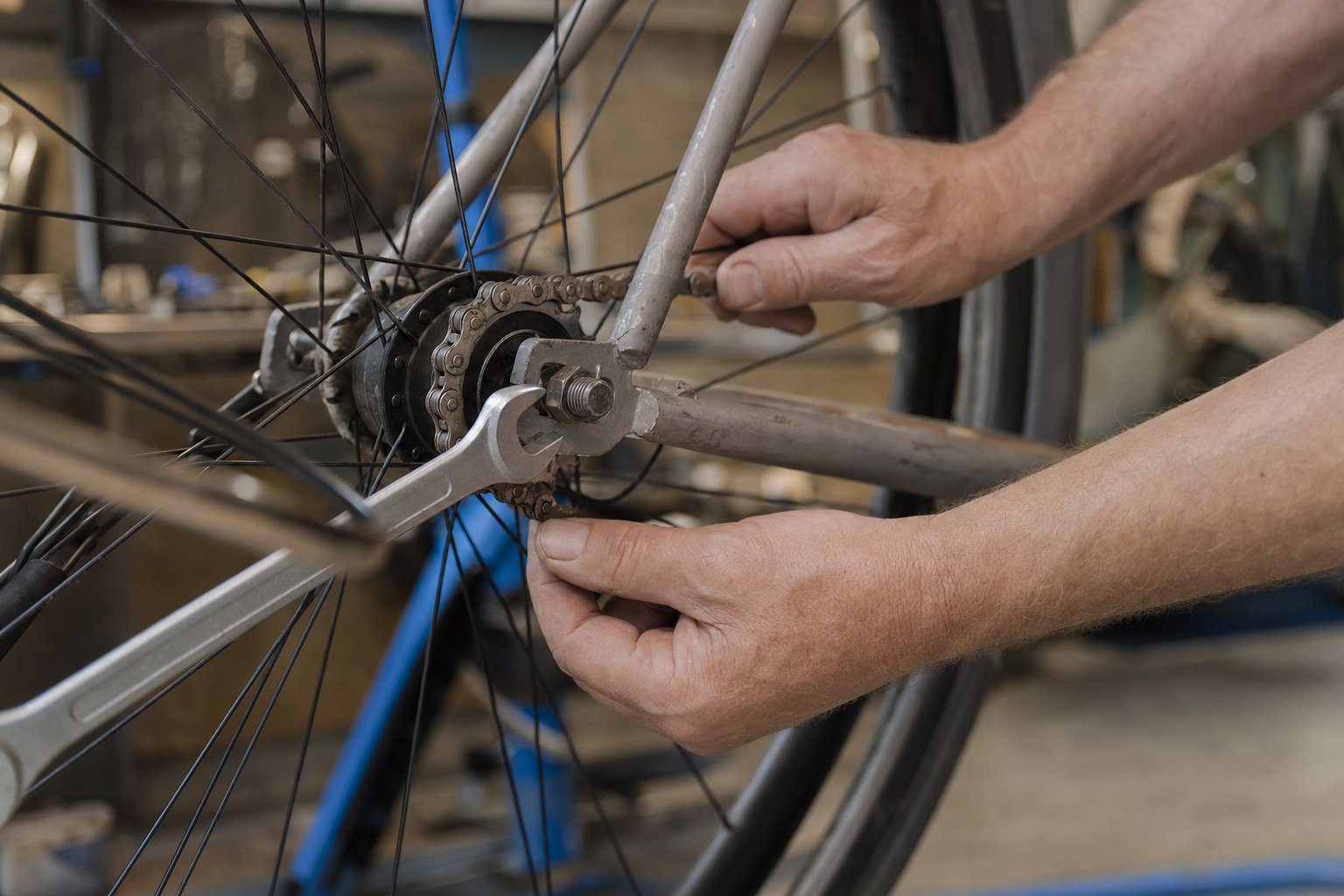
If your bike has horizontal dropouts — a singlespeed, fixed-gear, or most simple city commuters — the rear wheel itself sets the chain tension, and it's the only adjustment available. Loosen both rear axle nuts (usually a 15mm wrench), then pull the wheel straight back in the dropout slots until the chain has roughly half an inch to an inch of vertical play at the midpoint between the chainring and rear cog — enough slack to move a little, not enough to flop.
Keep the wheel centered while you tighten
The part that's easy to get wrong: the wheel has to stay centered in the frame as it moves back, or the bike will track crooked and rub against the chainstay. Eyeball it from behind before fully tightening, using the gap between the tire and each side of the frame as a reference. Snug the axle nuts down evenly and firmly — a torque wrench in the 80-100 Nm range if you have one, otherwise as tight as you can get it by hand without the wheel shifting — then spin the wheel to confirm the chain isn't now too tight to turn smoothly.
On a derailleur bike, a loose-feeling chain almost never means the chain needs tightening — it means something else needs attention.
Derailleur bikes: there's nothing to tighten
Road bikes, mountain bikes and most hybrids don't have a chain-tightening adjustment at all, because the rear derailleur's spring-loaded pulley cage takes up slack automatically across every gear. If the chain feels loose, skips under load, or slaps around, the real cause is usually one of two things: the chain itself has worn and stretched past its usable length (a $10 chain-wear checker tool tells you in seconds), or the derailleur's cable tension or limit screws need adjusting. Sliding the rear wheel back in a derailleur bike's dropouts doesn't fix either problem — it just changes wheelbase and throws off the derailleur's own tensioning range.
Singlespeed with vertical dropouts: you need a tensioner, not a wrench
A smaller category worth knowing about: some singlespeed conversions and a few dedicated singlespeed frames use vertical dropouts, the same style as a derailleur bike. There's no room to slide the wheel back and forth, so chain tension has to come from an external chain tensioner — a small spring-loaded arm, similar in principle to a mini derailleur, bolted near the rear dropout. If your singlespeed's rear wheel doesn't visibly move in a slot when you loosen the axle, this is the setup you actually have.
Run out of dropout slot to slide back into?
A singlespeed chain has a fixed number of links, so once you've slid the wheel as far back in the dropouts as it'll go and the chain is still loose, sliding it back further isn't an option — the fix is a half-link, a special short chain link that lets you adjust chain length in smaller increments than a full link allows. Without one, the only options left are moving to a shorter chain (removing a full link, which may then run too tight) or accepting the tensioner-based setup covered above instead.
This usually shows up gradually rather than all at once: a chain that needed re-tensioning every month a year ago and now needs it every week is stretching, and the dropout slot is quietly running out of room to compensate. Once you're near the end of the slot's travel, that's the signal to check for wear with a chain-wear tool rather than continuing to chase the slack with tension alone.

A couple of things people ask
How do I know if my chain is actually worn out instead of just loose?
A chain-wear checker tool (a simple go/no-go gauge) is the reliable way to tell — chains stretch as their internal pins and rollers wear, and once a chain passes a certain wear threshold, no amount of tensioning fixes the skipping or slipping. On a singlespeed, re-tensioning buys time; on a derailleur bike, a worn chain just needs replacing.
Can I add a chain tensioner to any singlespeed bike?
Most singlespeed conversions on a bike with vertical dropouts can take a bolt-on tensioner, but check your specific dropout and derailleur-hanger situation first — some frames need a specific tensioner style to clear the chainstay or fit the hanger bolt correctly.